



Cart 0

Throughout its sixty-six books written by some forty authors, the Bible contains several genealogies. While many readers today skip or skim over them, for those attempting to build a chronology and determine when certain events happened, they are of the upmost importance. Of course, there are a few problems along the way. One issue is that some of the genealogies are known to have ‘gaps’ within them. That is, they have missing generations. This is not a mistake by the author but rather is intentional. For example, in Matthew’s genealogy of Jesus he purposely omits certain generations so that it can be neatly divided into three groups of fourteen names each. (Matt. 1:1-17)
These gaps create questions surrounding other Biblical genealogies. Most notably Genesis 5 and 11 which help to establish a timeline for early Biblical history. Some scholars reason that because there are gaps in other Biblical genealogies then there are probably some in the Genesis genealogies as well. Furthermore, since “son” in the Bible can mean grandson, great-grandson, and so on, the Genesis genealogies (which actually use the term begat) may not necessarily be claiming a father-son relationship between ancestor and descendant. They also point to Luke’s Jesus genealogy which contains two men by the name of Cainan (Luke 3:36-37)—though only one is mentioned in Genesis. But are there truly missing generations in Genesis 5 and 11? Probably not.
As scientist, scholar, and researcher Paul Garner has documented in his excellent book The New Creationism, there are several reasons to believe that the genealogies in Genesis 5 and 11 are complete. First of all, “There is an interpretive principle that says Scripture compliments Scripture. In other words, what one book omits, another includes; what one writer says in full, another summarizes. When Matthew 1:8 tells us that Joram begat Uzziah he is missing out three generations—but we know this because the three names omitted here are found elsewhere in Scripture. In the case of the genealogies in Genesis the ‘missing’ generations can only be speculative because they are not supplied or referenced elsewhere.”

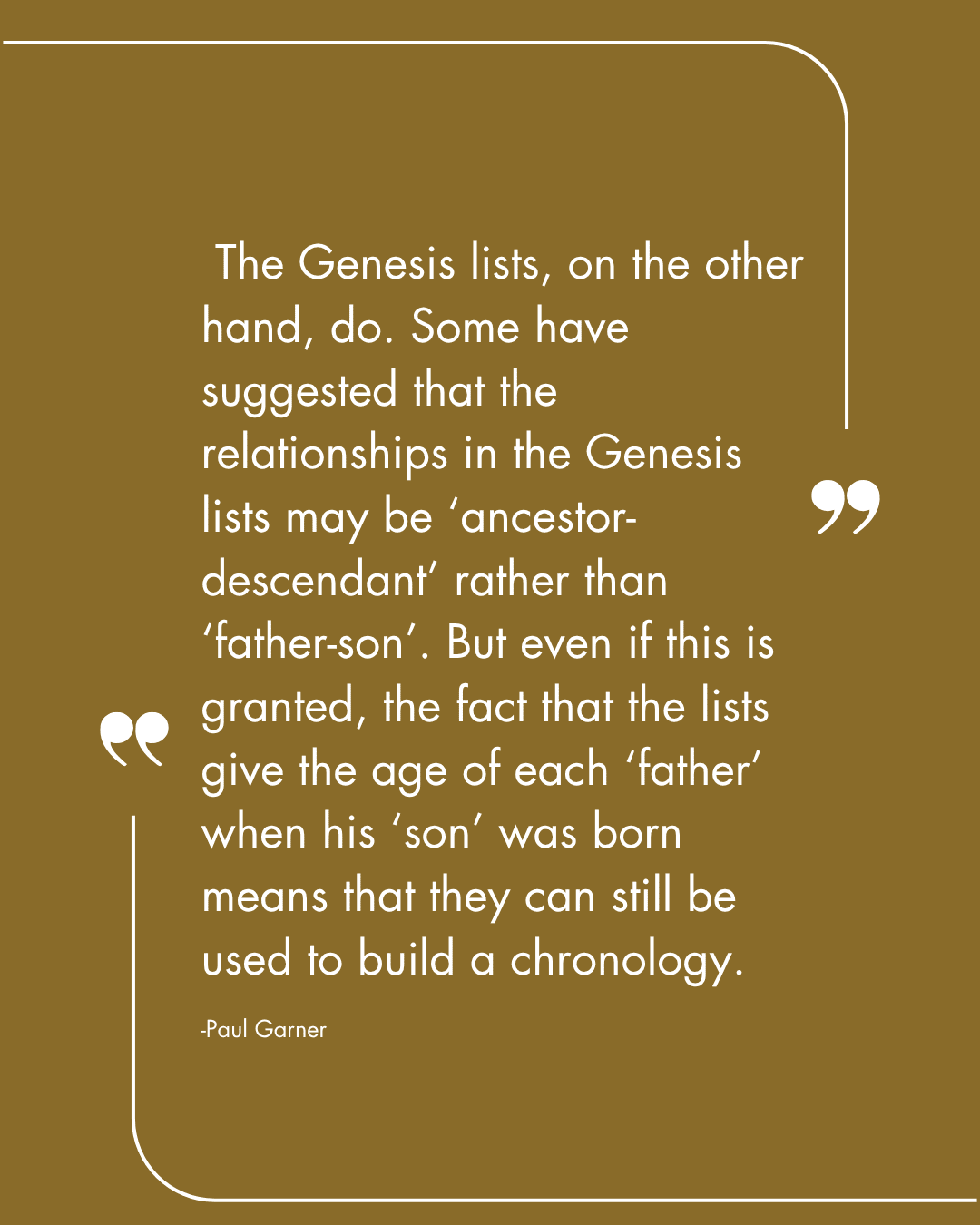
Second, there is a key difference between the Genesis genealogies and the genealogies with known gaps. “None of the lists with gaps mentions the age of the father at the birth of the next in line. The Genesis lists, on the other hand, do. Some have suggested that the relationships in the Genesis lists may be ‘ancestor-descendant’ rather than ‘father-son’. But even if this is granted, the fact that the lists give the age of each ‘father’ when his ‘son’ was born means that they can still be used to build a chronology. Consider, for example, the information provided in Genesis 5:9-11. Let us assume, for the sake of argument, that Cainan is actually the great-grandson of Enos. The text still says that Enos was ninety years old when Cainan was born—leaving the calculated chronology exactly the same as if he were his direct son.”
A third reason not to suspect any gaps in the Genesis 5 and 11 genealogies is because “In many places, cross-checks show that there is no gap. Consider the following:
• Seth is a direct son of Adam because he was seen as a replacement for Abel (Genesis 4:25).
• Enos is a direct son of Seth because Seth named him (Genesis 4:26).
• In Jude 14, Enoch is said to be ‘the seventh from Adam’, which seems to rule out any missing generations between Adam and Enoch.
• Noah is a direct son of Lamech because Lamech named him (Genesis 5:29).
• Shem, Ham and Japheth were direct sons of Noah because they were with him on the ark (Genesis 7:13).
• Arphaxad was a direct son of Shem because he was born two years after the Flood (Genesis 11:10).
• Abram, Haran and Nahor were clearly the direct sons of Terah (Genesis 11:26-31).
• The Hebrew name Methuselah may mean ‘when he dies it will come’. If there are no gaps in the family lists, it is interesting to note that Methuselah would have died in the same year that the Flood began.”
Okay, but what about the extra Cainan found in Luke’s genealogy? Most likely this is a copyist’s error since the name is not found in the earliest manuscripts of Luke’s gospel nor do any early commentators refer to it. Evidently then, the genealogies in Genesis 5 and 11 are intended to be taken as a straightforward history from Adam to Abraham with no gaps.

Ryan Hembree is a daily co-host, speaker, and writer of Bible Discovery. He also hosts a YouTube channel that shows the unity of the Bible and how science and Scripture fit together. Ryan also has an honorary Masters of Ministry in Creation Science from Phoenix University of Theology.
[1] Paul Garner, The New Creationism, P.68-69.
[2] Ibid., P.69
[3] Ibid., P.69-70.
[4] Ibid. P.70.