Cart 0
In John’s apocalypse, he said that “the testimony of Jesus is the spirit of prophecy” (Revelation 19:10). Understanding and interpreting prophecy, then, is essential to understanding God’s Word. One form of prophecy that is often overlooked in modern theology is typology––the study of types. In theology, a type is non-verbal prophecy consisting of signs, symbols, patterns, rituals, imagery, allusions and stories that point to a greater spiritual truth—it is how God speaks through the visible world and created order. New Testament authors sometimes refer to Old Testament types as “shadows” of things to come, distinct from the reality it is pointing to, namely, Christ (Hebrews 10:1; Colossians 2:16-17). Therefore, the overarching pattern of a narrative, the order and arrangement of events, may have profound typological significance for what is to come later. In other words, each type in a narrative sequence points to something much more important than itself.
For instance, Peter said that Noah’s Ark is a type of salvation, and that the flood is a type of baptism (1 Peter 3:20-21); elsewhere we read that the dove is a type of Holy Spirit, as one who brings the anointing (i.e., olive branch) and seal of new creation; hence why at Christ’s baptism the Holy Spirit descends upon Him like a dove––Christ is the Ark; He is our salvation (Matthew 3:16; 2 Corinthians 1:21–22). These OT types were all signs that point to something of greater significance than the sign itself: New creation life.
Now, types are more than just objects or events, they can be people, too. Adam is a type of Christ, of course (1 Corinthians 15:21-22,45), and so is Melchizedek, the priest-king of Salem (Hebrews 7:1-3). And since these types usually point to God, namely Christ, and His redemptive plan of salvation, their meanings tend to unify in a very intricate and multifaceted way.
Consider Holy Communion, which unifies two feasts into one typological whole under Christ: the Passover lamb is a type of Christ insofar that the blood of the lamb guarantees that death will pass over one’s household (Exodus 12:1-11; 1 Corinthians 5:7), and unified with that festival is Melchizedek’s holy supper of bread and wine in Genesis 14 after Abram defeated his enemies in battle and saved his nephew Lot. Harmonized, these types convey our covenantal vocation: having been saved from death by the blood of the lamb over our house, that is our body and the church body (1 Corinthians 3:16-17,6:19-20), we now go out into the world wearing the full armour of God and defeat the enemies of darkness in spiritual battle to save those captured by sin (Ephesians 6:10-20; 1 Timothy 4:16), and then we, too, as Abraham’s promised children, partake in the Lord’s Supper with our high priest-king of new Jerusalem in His holy temple, that is the body of Christ.
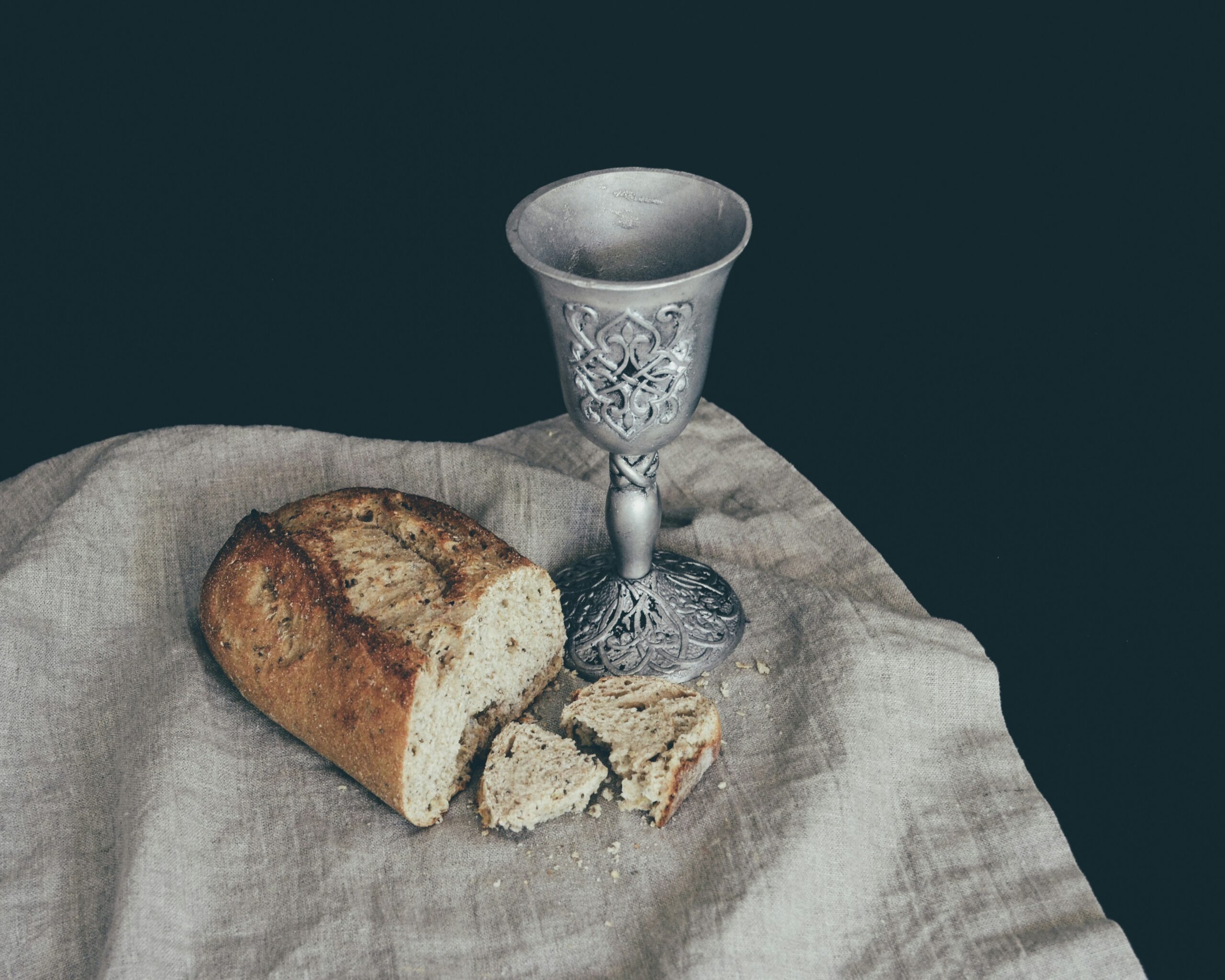
This harmonization of the Lord’s Supper with spiritual warfare tells us something deeply important about our participation in Christ’s incarnation and sacrifice. Paul says to the Corinthians:
The cup of blessing that we bless, is it not a participation in the blood of Christ? The bread that we break, is it not a participation in the body of Christ? …. For as often as you eat this bread and drink the cup, you proclaim the Lord’s death until he comes. (1 Corinthians 10:16, 11:26)
Paul says, here, that Communion is not only a “participation” in Christ’s blood sacrifice, that is to have communion or fellowship with His sacrificed body and propitiatory blood, but that when we partake of the elements we “proclaim” the gospel. Now consider what Hebrews 13 says:
So Jesus also suffered outside the gate in order to sanctify the people through his own blood. Therefore let us go to him outside the camp and bear the reproach he endured. For here we have no lasting city, but we seek the city that is to come. Through him then let us continually offer up a sacrifice of praise to God, that is, the fruit of lips that acknowledge his name. Do not neglect to do good and to share what you have, for such sacrifices are pleasing to God. (Hebrews 13:12-16)
So––according to Paul, Communion is a form of evangelism, and according to Hebrews, evangelism is a form of sacrifice; both of which are participatory, a means of grace. Therefore, our evangelistic participation in the body and blood of Christ, that is the Lord’s Supper, entails perseverance, endurance, suffering, and persecution outside the camp, as goes with any war (1 Corinthians 10:16-17; Hebrews 13:12-16; Philippians 1:29; 2 Timothy 3:12). We are in a covenant, after all. A covenant that fights not against flesh and blood but preaches the good news of Jesus Christ, in word and in deed, against the celestial powers of darkness––and our soul is the battlefield, but our body is still the front lines in this world.
Paul further touches on the spiritual importance of the Lord’s Supper and how the disposition of our hearts is vital for how we participate in His crucifixion, when he chastised the Corinthian believers for partaking in Communion in an “unworthy manner”. If you recall, they were found “guilty concerning the body and blood of the Lord” (v.27), and so, in a twist of divine irony, died as a result (vv.27-32). The typological earmark of Christ’s atonement, the sacrifice of the Passover lamb, meant that death had passed over. They did not take that prophecy to heart. Paul likens this twist of fate to God’s discipline, a severe warning to avoid a worse death: condemnation (v.32). By actively partaking in the Lord’s Supper, you are actively participating and proclaiming that once for all sacrifice Christ made on the cross, in body and in soul, in word and in deed, which is why the Lord’s discipline was so severe.
Communion is the gospel, and the gospel is spiritual warfare.

Matlock Bobechko is the Chief Operating/Creative Officer of Bible Discovery. He is an eclectic Christian thinker and writer, award-winning screenwriter and short filmmaker. He writes a blog on theology, apologetics, and philosophy called Meet Me at the Oak. He is also an Elder at his local church.